Now that we have gotten a grip over the basics of arrays ( part one and part two ), we will discuss some basic code examples involving arrays.
This is shown in the examples below:


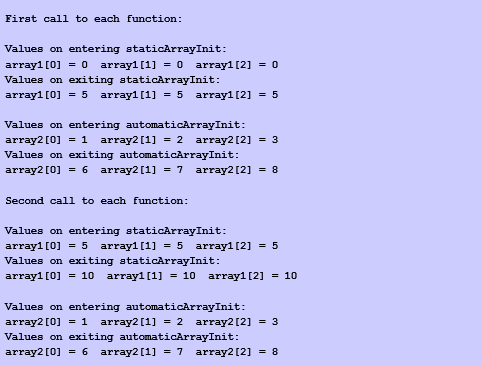


Strings:
Strings can be considered as arrays of characters;
– All strings end with null ('\0')
– Examples
•
char string1[] =
"hello";
– Null character implicitly added
– string1 has 6 elements
•
char string1[] = { 'h', 'e',
'l', 'l', 'o', '\0’ };
–
Subscripting is the same
string1[ 0 ] is 'h'
string1[ 2 ] is 'l'
• Input from keyboard
char string2[ 10 ];
cin >> string2;
–
Puts user input in string
•
Stops at first whitespace character
•
Adds null character
– If too much text is entered then the data is written beyond array
• Printing strings
– cout << string2 << endl;
•
Does not work for other array types
–
Characters printed until null found
Static Arrays:
Recall
static storage
–If
static,
local variables save values between function calls
–Visible
only in function body
–Can
declare local arrays to be static
•Initialized
to zero
static int array[3];
If
not static
–Created
(and destroyed) in every function call
Sorting data using Arrays:
Before getting into this example we should first know what Sorting data is, it is:
– An important computing application
– Virtually every organization must sort some data
•
Massive amounts must be sorted
• Bubble sort
– Several passes through the array
– Successive pairs of elements are compared
•
If increasing order (or identical), no change
•
If decreasing order, elements exchanged
–
Repeat these steps for every element
• Example:
–
Go left to right, and exchange elements as
necessary
•
One pass for each element
–
Original:
3 4 2
7 6
–
Pass 1:
3 2 4 6
7
(elements exchanged)
–
Pass 2:
2 3 4
6 7
–
Pass 3:
2 3 4
6 7 (no changes needed)
–
Pass 4:
2 3 4
6 7
–
Small elements "bubble" to the top
(like 2 in this example)
•
Swapping variables
int x = 3, y = 4;
y = x;
x = y;
•
What happened?
–
Both x and y are 3!
–
Need a temporary variable
•
Solution
int x = 3, y = 4, temp = 0;
temp = x; // temp
gets 3
x = y; // x
gets 4
y = temp; // y
gets 3
Computing Mean, Mode and Median using Arrays:
First lets just look at what mean , median and mode actually are:


•Mean
–Average
(sum/number of elements)
•Median
–Number
in middle of sorted list
–1,
2, 3, 4, 5 (3 is median)
–If
even number of elements, take average of middle two
•Mode
–Number
that occurs most often
–1,
1, 1, 2, 3, 3, 4, 5 (1 is mode)
Now lets look at how we'll compute these.


Post a Comment